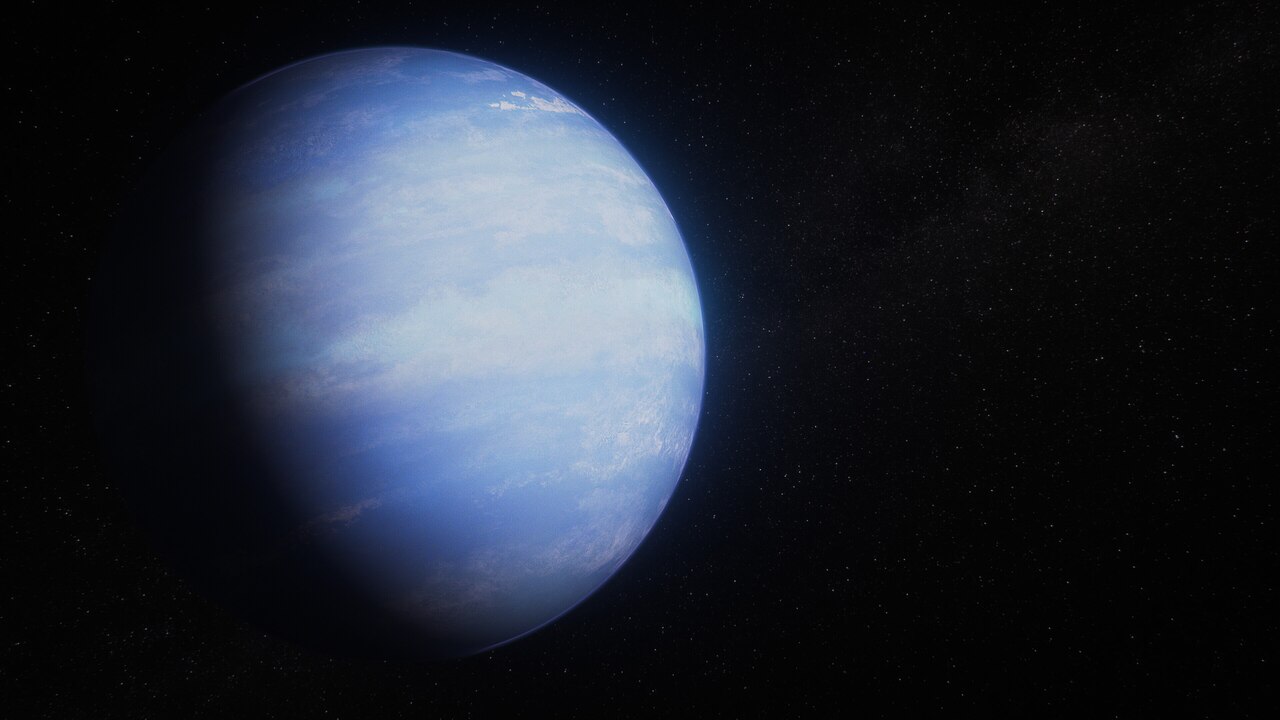
Sub-Neptune hazes are one of the big open questions in exoplanet atmospheres, and a new paper by A. Y. Jaziri, T. Drant and M. Turbet takes a fresh look at them. It is on arXiv and, according to the listing, has been accepted in Astronomy & Astrophysics. So it is worth reading, but it is still fresh and the community has not had time to react.
Why hazes matter
Sub-Neptunes are planets between the size of Earth and Neptune, and they are the most common type we have found around other stars. Many of their spectra look flatter than expected. A popular explanation is photochemical haze: tiny particles made when starlight breaks up molecules high in the atmosphere. Early Hubble observations hinted that hotter planets were hazier. JWST data, however, looks much more mixed.
What the team did
Different teams use different methods, which makes comparing planets difficult. Here the authors ran one consistent retrieval on eight moderately irradiated sub-Neptunes: LP 791-18 c, TOI-1231 b, TOI-732 c, TOI-270 d, GJ 1214 b, GJ 9827 d, GJ 3090 b and TOI-421 b. They compared a haze-free model with two models using haze properties measured in laboratory experiments, rather than invented ones.
The results:
- LP 791-18 c, TOI-732 c and GJ 3090 b show significant evidence for haze.
- For LP 791-18 c and GJ 3090 b, that evidence may be biased by contamination from the host star’s surface (the transit light source effect).
- TOI-270 d shows no significant evidence for haze, and its haze properties shift depending on instrument offsets and temperature assumptions.
- The haze preference mostly comes from the slope of the spectrum at short wavelengths, not from the infrared absorption features of the lab hazes. TOI-732 c is the exception.
- The amount of methane does not clearly track haze, so composition and photochemistry both seem to matter.
My take
The honest summary is that there is no universal haze trend in this sample. Eight planets is a small group, only two haze types were tested, and the retrievals have degeneracies. Starspots and similar stellar effects can fake or hide a haze signal. The authors say better stellar characterization, improved contamination corrections and more laboratory data could bring the picture closer to the old Hubble trend.
There is no biosignature claim here, and none should be read into it. Still, I care about this work for habitability. If we cannot tell haze from stellar noise in a puffy sub-Neptune, reading the gases in a small, possibly habitable world will be even harder. I will be watching for phase curve and multi-wavelength follow-up, which the authors say would help separate aerosols from the star.