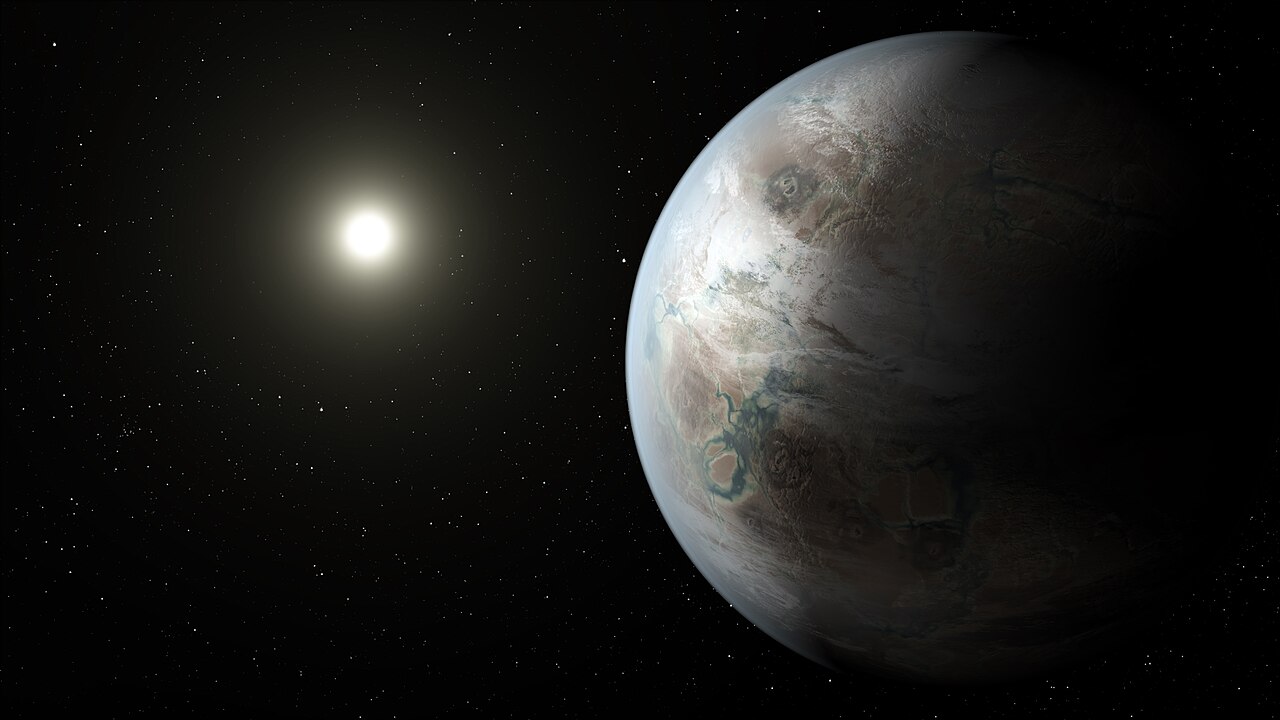
Well, this one is not a discovery of a new world, but I find it exciting anyway. A team led by Md Abdullah Al Zaman, with Ian Crossfield and colleagues, has re-analysed 187 confirmed and candidate planets from the Kepler mission that orbit in or near the habitable zone of Sun-like stars. The paper on arXiv was posted on 21 November 2026 and, according to the listing, has been accepted by The Astronomical Journal.
What they did
Kepler found its planets by watching stars dim slightly as a planet crosses in front of them. The trouble is that the numbers we have for these planets are only as good as the numbers we have for their stars, and those were often uncertain.
The team did two main things:
- They ran a homogeneous transit light-curve analysis on all 187 systems, so every planet is treated the same way.
- They used stellar parameters derived from Gaia DR3, which gives better stars and therefore better planets.
They also statistically validated all the targets, which means estimating how likely each signal is to be a real planet rather than a false positive, such as a background eclipsing binary. The result is a uniform catalog of planetary radii, instellation fluxes (how much light a planet receives compared with Earth) and orbital ephemerides, meant to help astronomers decide which targets deserve telescope time.
What follow-up could bring
The most concrete number in the abstract is this: the authors say a single transit observed by JWST (6 m) or the planned Lazuli telescope (3 m) could measure a planet’s radius about twice as precisely as four years of Kepler data. They also find that systems with periods longer than 300 days benefit most from transit follow-up. Those are the Earth-like orbits, where Kepler only caught a few transits.
Limits to keep in mind
This is a refinement, not a detection. I only read the abstract page, not the full paper, so I can’t tell you the detailed validation statistics or the final uncertainties on radius and flux. The precision gain from JWST or Lazuli is also a projection, not something already demonstrated. Some candidates may stay in the “probably a planet” bucket until follow-up observations are made. And the authors themselves note that a much larger sample has to wait for new wide-field space surveys.
My take
My analysis: clean, consistent numbers matter a lot here. Whether a planet is rocky or puffy, and whether it gets Earth-like light or too much, can change with a small shift in the star’s size. A uniform catalog like this tells us where to point our best telescopes, and the long-period planets are the ones I will be watching. They are the closest Kepler came to showing us a true Earth analogue. I will look for the full paper and the catalog once they are out.