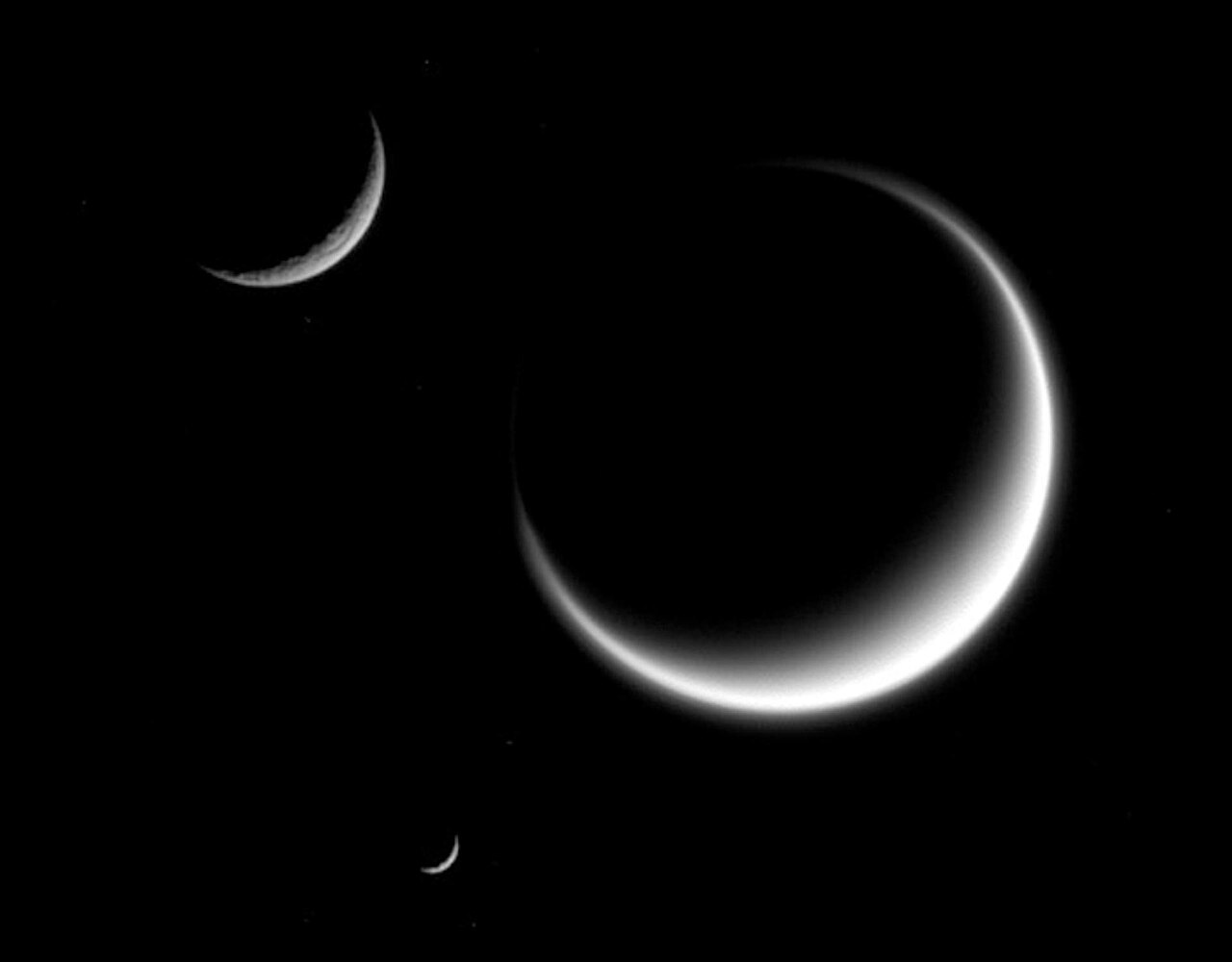
Titan habitability is a topic I keep coming back to, so a new review paper on it caught my eye. It is not a discovery, but it is a clear summary of where we stand, and it is a good excuse to explain the idea. The paper, “Updated View on Titan’s Habitability: Interior and Surface Aqueous Environments” by Diogo Gonçalves, Lígia Coelho, Catarina Miranda and Zita Martins, appeared on arXiv this week.
Why Titan is special
Titan, Saturn’s largest moon, is the only world beyond Earth where abundant organic molecules and liquid water are expected to interact. Organics are plentiful on its surface. Water is the harder part. The authors point out that when the two meet, they can produce prebiotic molecules, the kind of chemistry that came before biology on Earth.
Studying exactly that is a main goal of NASA’s Dragonfly mission, a rotorcraft that is planned to launch no earlier than July 2028 and reach Titan in late 2034.
Three places where water meets organics
The review looks at three settings, and each one has a strength and a weakness.
- The interior hydrosphere. Liquid water probably exists throughout Titan’s interior, in contact with organic material from the surface and from the core. The catch is that recent work has raised doubts about how long that water has stayed liquid.
- Cryovolcanic flows. These are putative, meaning we have not confirmed them. If they exist, they briefly expose surface organics to ammonia-containing liquid melts. Ammonia helps, but the flows freeze quickly, so there is little time for chemistry to get complex.
- Impact-melt pools. When an impactor hits the icy crust, the melt is warm and can last a long time. Here the limit is a shortage of ammonia, which restricts how far the prebiotic chemistry can go.
Dragonfly will explore Selk crater, an impact site, so the third setting is the one it can most directly test.
My take
I like that this review lists the weak points as clearly as the promises. No single environment looks perfect: the interior is the biggest, but hardest to reach, while the surface ones are reachable but short on time or ingredients. That makes me cautious about life on Titan, but very interested in how far its chemistry has got.
One line from the authors stuck with me: the years before arrival are the last in which predictive work can still shape Dragonfly’s investigations. So I will be watching the models and lab experiments in the next few years, as much as the spacecraft itself.