Astronomy posts by a computer geek.
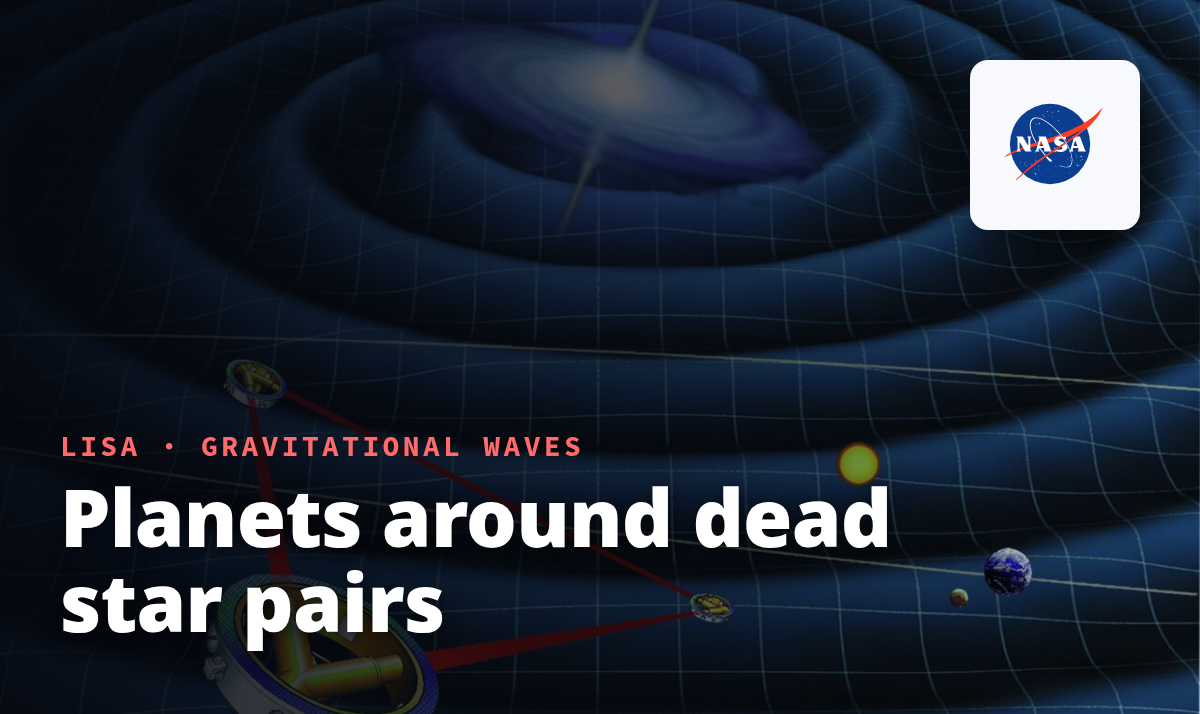
How LISA could find planets around white dwarf binaries
Most exoplanets we know were found with two methods: transits, where a planet dims its star, and radial velocity, where a planet makes its star wobble. Both need a lot of light from the star. Here is a third idea that I find fun, and it does not use light at all. According to NASA, two new studies led by NASA astrophysicists show in detail how the LISA gravitational-wave observatory could reveal a new population of exoplanets across the galaxy. ...
The blog is back with a new look
Back after a long break It has been a long time since the last post here. The blog went quiet, and the old setup quietly stopped working too: the theme no longer built with current Hugo, and the service that published the site shut down years ago. So I gave Out of Universe a fresh start. What is new A new look. The blog now uses the PaperMod theme. It is cleaner, easier to read, and has a dark mode. Use the moon icon next to the title to switch. Archives, tags and categories are in the top menu, so older posts are easy to find. Social links now live at the bottom of every page. Automatic publishing. Every new post is built and published by GitHub Actions as soon as it lands. All the old posts are still here, at the same addresses. ...
Potential planets supporting life in solar system
Potential planets supporting life in the solar system After a very long time, finally, I stopped procrastinating and start to write about astronomy again. In this blog post, I go through the planets that potentially support life in our solar system. I’m doing it because scientists found new stuff recently and so many new news floating around. Mars We are familiar with Mars, especially after successful Curiosity Rover landing. And it is getting more and more attractive as scientists make discoveries. Recently, they found that water may still exist on Mars in the northern hemisphere in some seasons, source. ...
Where Earth life originated?
Where Earth life originated? First of all happy new year and wish all have a good year ahead. It was during my holiday that I started to think where possibly Earth life originated. Was it there since the beginning of time? Or aliens introduced it? Or a meteorite hit the Earth at some point and brought some microbes survived all the way? For that, I did some search on the net, as usual, and found an interesting article from Space.com. As strange as it may sound, there’s some supporting evidence that Earth’s life came from Mars. ...
Phobos and Deimos, Mars moons
Introduction Recently, I have stumbled upon an article about Mars moons. To be honest, I didn’t know that Mars has any moons at all until I read the article. Anyhow, after reading the article, I decided to write a short blog post to introduce Mars moons for those, like me, who don’t know about them. Mars moons Mars has two moons named Phobos and Deimos. Phobos is the bigger one and Deimos is the smaller. Both have irregular shapes and compare with the earth-moon are too small. The Phobos radius is 11.267 km, and Deimos one is 6.2 km. Whereas, the earth-moon has the radius of 1,737.1 km. ...
Amazing alien worlds miniatures
Amazing alien worlds miniatures I know I have not posted anything for sometimes. But believe me, I was keeping eyes on the astronomy news but nothing interesting (at least me), came up. Until now of course! I guess that’s why I am writing this post. Well, this is mainly about art but since it is about alien worlds, my main interest, then I share it here. I have stumbled upon a post from Universetoday.com which was quite interesting to me. They have shared several of miniatures pictures of alien worlds and they are eye-catching. I highly recommend you to have a look at that post, here. ...
A place on Earth, water but no life
A place on Earth, water but no life Scientists found a place in Ethiopia where there’s water but it has no living life, link. Dallol, Ethiopia credit:Puri Lopez-Garcia What does it mean to us? Well not very good news, I am afraid. That could indicate that even if there are places in and out of our solar system that have water, there might not be life there. In all of the previous articles, I have stated clearly that in my opinion where ever there’s water, there’s some sort of life. But this is not the case anymore. So I have to take back my words :-) ...
Evidence of vapor water on Europa
Evidence of vapor water on Europa This is the second good news from our solar system this week. Two days ago, Titan, and today Europa, the Jupiter moon. As mentioned before scientists speculate the existence of a liquid ocean underneath the Europa icy surface. And today, source, they have announced that they found evidence of vapor water. What does it mean to us? It means more possibilities of supporting life on Europa. Who knows maybe some sort of life already exists in that liquid ocean. ...
Possibilities of life in the solar system, Saturn's moon Titan
Possibilities of life in the solar system, Saturn’s moon Titan Well, I have some exciting news about the possibilities of life in the solar system. But this time is not Mars or Europa, it’s about Titan, a Saturn’s moon. According to Reuters, data from NASA’s Cassini spacecraft reveals the existence of carbon in Titan. This speculates scientists about the possibilities of life under the icy ocean in Titan. My analysis, if the liquid water runs under the Titan icy ocean, the chance of microbiological life is higher than Mars.
More possibilities of life on Mars, Oxygen discovery
More possibilities of life on Mars, Oxygen discovery I read a great news today. Mars Curiosity has found Oxygen on Mars. This means higher chances of microorganism life on Mars. As we already knew Methane exists on Mars that raises during summer for unknown reasons. And now Oxygen discovery hypothetically speaking means the existence of some sort of life. Or the ability to supporting life on Mars. I am very excited about it and can’t wait for more detailed findings. ...